
Zero Trust Security: Why Modern Businesses Need a New Approach to Network Protection
Traditional network security often works on the idea that users and devices inside a company’s network can be trusted. However, modern businesses no longer operate entirely within one physical office network.
Employees work remotely, businesses use cloud applications, multiple devices connect to company systems, and data may be accessed from different locations. These changes have made traditional perimeter-based security less effective on its own.
This is where Zero Trust Security provides a different approach.
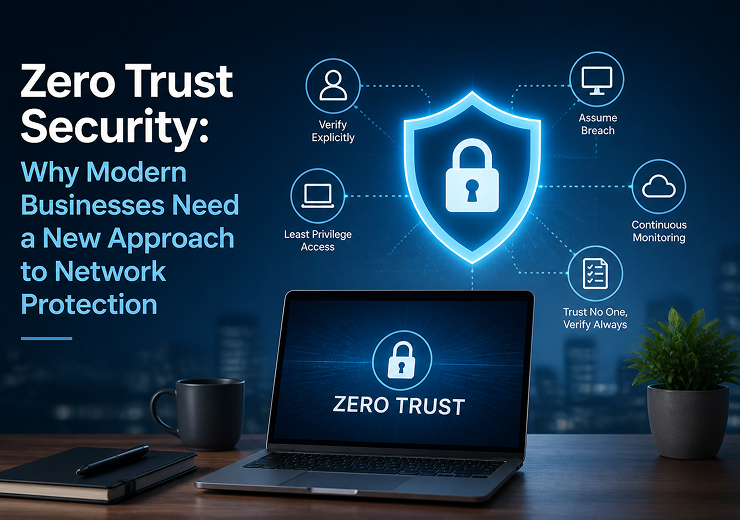
Zero Trust follows a simple principle: do not automatically trust users or devices simply because they are inside a network. Access should be verified based on identity, device, permissions and other security requirements.
For businesses looking for Zero Trust Security Services in Coimbatore, understanding this approach can help them build a stronger and more flexible security strategy.
What Is Zero Trust Security?
Zero Trust Security is a security approach where users, devices and applications are not automatically trusted.
Instead, access requests are continuously evaluated according to security policies.
A Zero Trust environment focuses on:
- Verifying user identity
- Checking device security
- Limiting access permissions
- Protecting applications and data
- Monitoring activity
- Reducing unnecessary network access
The goal is to reduce the impact of compromised accounts, devices or applications.
Zero Trust is not simply a single security product. It is an overall security strategy that can involve identity management, endpoint security, network security, application protection and data security.
Why Traditional Network Security Is Changing
Traditional network security commonly relies on a strong boundary around the organization’s internal network.
Firewalls and other network security controls remain important, but modern IT environments have become more distributed.
Businesses may now have:
- Remote employees
- Cloud applications
- Multiple offices
- Mobile devices
- SaaS platforms
- Third-party services
- External business partners
Because users and applications can access resources from different locations, businesses need security controls that work beyond the traditional office network.
Zero Trust provides a framework for managing this changing environment.
Why Businesses Need Zero Trust Security
Protect Remote Workers
Remote employees may access business systems from outside the office. Zero Trust can help ensure that access is based on identity and security policies rather than simply network location.
Reduce Unauthorized Access
Access can be limited according to the user’s role and business requirements.
Protect Cloud Applications
Cloud applications may be accessed from different locations and devices. Zero Trust principles can help businesses apply consistent access controls.
Reduce Security Risks
If an account or device becomes compromised, limiting permissions can reduce the potential impact.
Improve Visibility
Monitoring user and device activity can help organizations identify unusual behaviour and security issues.
Key Principles of Zero Trust Security
A strong Zero Trust strategy generally focuses on several important principles.
- Verify Every Access Request
Users should not automatically receive access simply because they are connected to the company network.
Identity and access should be verified before granting access to protected resources.
- Use Least-Privilege Access
Users should receive only the access required to perform their job.
For example, an employee who only needs access to a specific business application may not need access to the entire internal network.
Least-privilege access can reduce unnecessary exposure.
- Secure Devices
A user’s identity is only one part of the security process.
Businesses should also consider the security condition of the device being used.
Important checks may include:
- Device updates
- Security software
- Device configuration
- Encryption
- Device compliance
- Monitor User and Device Activity
Zero Trust is not only about granting or denying access.
Organizations should monitor activity to identify unusual behaviour and potential security incidents.
Monitoring can help security teams understand:
- Who accessed a resource
- Which device was used
- What application was accessed
- When access occurred
- Whether the activity appears unusual
Zero Trust and Multi-Factor Authentication
Multi-factor authentication is an important security control that can support Zero Trust.
Instead of depending only on a password, MFA requires additional verification during authentication.
For example, authentication may involve:
- Username and password
- A verification code or authentication application
- Another approved authentication factor
MFA can help reduce the risk of unauthorized access when passwords are stolen or compromised.
Businesses should especially consider strong authentication for administrator accounts, remote access and important business applications.
Zero Trust and Endpoint Security
Every connected device can become a potential entry point for attackers.
Therefore, Zero Trust works closely with endpoint security.
Businesses should consider whether devices are:
- Properly updated
- Protected with security software
- Authorized to access company resources
- Configured according to security policies
- Regularly monitored
Combining Zero Trust Security and Endpoint Security can provide stronger protection for users and devices.
Zero Trust and Network Security
Zero Trust does not mean that traditional network security is no longer required.
Firewalls, network monitoring, segmentation and other security controls can continue to protect the infrastructure.
The difference is that Zero Trust adds stronger identity- and access-based controls.
Traditional Network Security | Zero Trust Security |
Focuses strongly on network boundaries | Focuses on identity, devices and resources |
Trust may depend on network location | Access is continuously evaluated |
Mainly protects network perimeter | Protects users, applications and data |
Internal access may be broader | Uses least-privilege access |
Works mainly around network infrastructure | Works across modern distributed environments |
Both approaches can work together as part of a wider cyber security strategy.
Zero Trust for Cloud-Based Businesses
Cloud adoption has changed how businesses access applications and data.
Employees may use cloud services from offices, homes and other locations. This makes identity and access management increasingly important.
Zero Trust can help businesses apply access policies based on:
- User identity
- Device status
- Application
- Location
- Security requirements
- User permissions
This can provide a more controlled approach to accessing cloud resources.
Zero Trust for Growing Businesses
As organizations grow, they often add more employees, devices, applications and locations.
Without a structured access strategy, users may gradually receive more permissions than they actually require.
A Zero Trust approach can help businesses establish clearer security policies.
It can support:
- New employee onboarding
- Role-based access
- Remote employee security
- Cloud application access
- Device management
- Access reviews
This makes Zero Trust particularly useful for organizations building a scalable security environment.
Benefits of Zero Trust Security
- Stronger Access Control
Access can be limited according to user roles and business requirements.
- Better Protection for Remote Access
Security policies can be applied even when employees work outside the office.
- Reduced Attack Surface
Limiting unnecessary access can reduce the number of resources exposed to compromised users or devices.
- Improved Visibility
Monitoring user and device activity can provide better awareness of potential threats.
- Better Cloud Security
Zero Trust principles can support secure access to cloud applications and services.
- Scalable Security
Zero Trust can adapt as businesses add users, devices, applications and locations.
How to Build a Zero Trust Security Strategy
Businesses can follow a structured process when moving towards Zero Trust.
Step 1: Identify Users and Devices
Create an inventory of employees, devices, applications and important business resources.
Step 2: Identify Critical Data
Determine which applications and data require stronger protection.
Step 3: Review Existing Access
Identify users who have unnecessary or excessive permissions.
Step 4: Implement Strong Authentication
Use MFA and appropriate identity controls for important systems.
Step 5: Apply Least Privilege
Provide users only the access required for their roles.
Step 6: Secure Endpoints
Ensure devices accessing business resources meet appropriate security requirements.
Step 7: Monitor and Review
Regularly review access, device activity and security events.
Zero Trust should be treated as an ongoing security strategy rather than a one-time implementation.
How to Choose a Zero Trust Security Company in Coimbatore
When selecting a Zero Trust Security Company in Coimbatore, businesses should consider the provider’s overall security capabilities.
Cyber Security Expertise
The provider should understand modern cyber security risks and business IT environments.
Identity and Access Management
Ask how the provider will manage user authentication and access permissions.
Endpoint Security
The Zero Trust strategy should consider the security status of connected devices.
Network Security
The provider should understand firewalls, network monitoring and segmentation where required.
Cloud Security
If the business uses cloud applications, the provider should be able to consider cloud access and security requirements.
Ongoing Monitoring
Security should be regularly monitored and reviewed rather than implemented only once.
Zero Trust Security Services by Virtual Automation
Virtual Automation provides business-focused IT and security capabilities across areas including Cyber Security, Network Security, Managed IT, Cloud Services, Backup & Recovery and IT Infrastructure.
These capabilities can support businesses as they strengthen access control and overall IT security.
Businesses considering a Zero Trust approach may need support with:
- Cyber Security
- Network Security
- Endpoint Protection
- Cloud Security
- IT Infrastructure Management
- Backup & Recovery
- Technical Support
A broader security strategy can help organizations protect users, devices, applications and business data.
Industries That Can Benefit from Zero Trust Security
Zero Trust principles can support businesses across multiple industries.
Manufacturing
Protect business systems and connected devices used across operational environments.
Healthcare
Apply stronger access controls to systems containing important organizational information.
Education
Manage access across staff, systems and connected devices.
Retail
Protect business applications and systems accessed by employees across different locations.
Logistics
Secure access to operational and business management systems.
Corporate Offices
Support secure access for employees, remote workers and business applications.
Small & Medium Businesses
Build structured access controls as the organization grows.
Why Choose Virtual Automation?
A Zero Trust strategy should work alongside other IT and cyber security controls.
Virtual Automation provides capabilities in:
- Cyber Security
- Network Security
- Cloud Services
- Managed IT Services
- IT Infrastructure Management
- Backup & Recovery
- Technical Support
This broader approach can help businesses strengthen their security environment instead of treating network protection as a standalone requirement.
Conclusion
Modern businesses can no longer depend entirely on traditional network boundaries for security. Remote work, cloud applications, mobile devices and distributed IT infrastructure have changed how users access business resources.
Zero Trust Security provides a modern approach by requiring businesses to verify access, apply least-privilege permissions, secure endpoints and monitor activity.
For organizations looking to strengthen their network and IT security, Zero Trust can become an important part of a broader cyber security strategy.
By working with an experienced Zero Trust Security Company in Coimbatore, businesses can develop security controls that support their users, devices, applications and long-term growth.